
Home / The saints / St. Catherine of Siena
Avignon, June 1376
A young woman from Siena arrives at the papal court in Avignon.1
She has been imploring the pope to leave Avignon, reform the clergy and return to Rome.1
She held no office of any kind. Within months, the pope was back in Rome.
Patron of Europe2
01St. Catherine of Siena
Letters to the powerful
Catherine dispatched letters to men and women in every condition of life, and corresponded with the princes and republics of Italy.1
In Siena she dictated her Dialogue, the book of her meditations and revelations.1
02St. Catherine of Siena
Patron of Europe
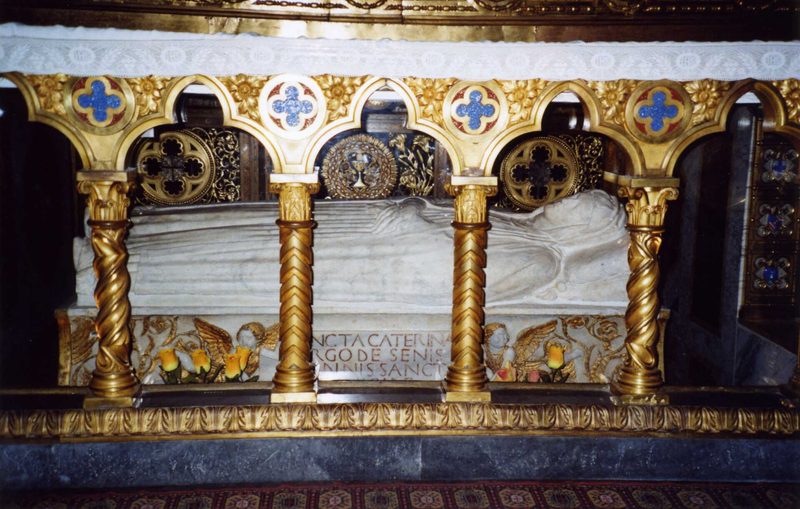
She died in Rome on 29 April 1380.1
St. John Paul II proclaimed her a co-patroness of Europe in 1999.2
Live it this week
Write the honest letter
Catherine wrote to popes and princes and told them the truth with love. Write one honest, kind letter or email this week to someone you’ve been avoiding a hard conversation with. Read it out loud once before you send it, to check the kindness.
Notes
How we know · 2 sources for this page
- Catholic Encyclopedia (1913), “St. Catherine of Siena”. New Advent edition. newadvent.org
- Pope St. John Paul II, Apostolic Letter Spes Aedificandi, proclaiming co-patronesses of Europe, 1 October 1999. Holy See, official English text. vatican.va
The Catholic Encyclopedia (1913) is in the public domain; we quote the New Advent edition. Texts of the Holy See are quoted briefly from vatican.va. Scripture: World English Bible, Catholic edition (public domain); Verse numbers are modern, with Douay-Rheims numbers in brackets where they differ. Photographs: Wikimedia Commons, credited under each image; full list on the photo credits page.
Lines in the narrator’s voice, without a note, are our reflection, not a historical claim. Stone & Incense restates Church teaching in plain words; our wording is not an official Church text. Report an errorCorrections.