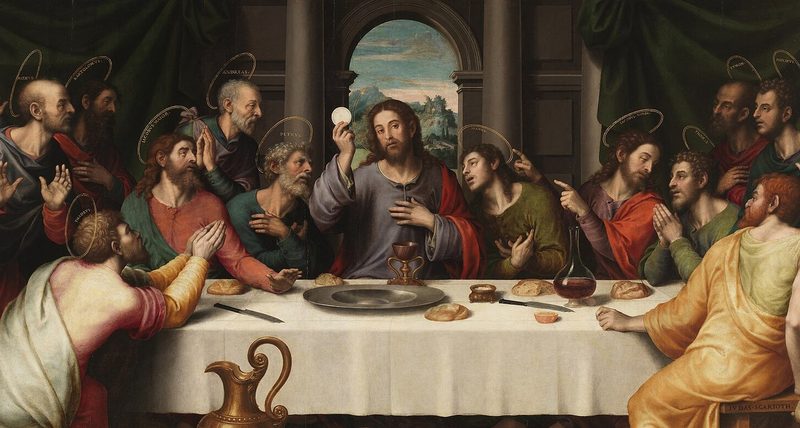

Rome, around the year 155
St. Justin, a Christian teacher, writes to the pagan emperor Antoninus Pius around the year 155, explaining what Christians actually do.3
He describes their Sunday: “And on the day called Sunday, all who live in cities or in the country gather together to one place.” The writings of the apostles and the prophets are read, the one presiding preaches, and then bread and wine are brought.4
Then Justin tells the emperor what Christians believe that food is. Before we hear him, go back to where it started.
01The source
Jesus
“He who eats my flesh and drinks my blood lives in me, and I in him.”
Next, Paul, writing to a church in Greece about what Jesus did at the Last Supper.
02Around the year 56
Paul
Paul handed on the Lord’s words, “This is my body,” and warned that whoever eats unworthily “will be guilty of the body and the blood of the Lord.”78
You cannot be guilty of the body of someone who is only symbolized.
And the generation after the apostles? One of them wrote about it on the road to his death.
03Around the year 110
Ignatius of Antioch
Ignatius warned against people who stayed away from the Eucharist “because they confess not the Eucharist to be the flesh of our Saviour Jesus Christ, which suffered for our sins.”1
“They abstain from the Eucharist and from prayer, because they confess not the Eucharist to be the flesh of our Saviour Jesus Christ, which suffered for our sins, and which the Father, of His goodness, raised up again.”
Now, back to Justin, and the emperor reading his letter.
04Around the year 155
Justin Martyr
Justin wrote: “not as common bread and common drink do we receive these.” The food blessed by the prayer of his word, he said, “is the flesh and blood of that Jesus who was made flesh.”2
The Catechism says the basic lines of the celebration Justin described have stayed the same until our own day for all the great liturgical families.3
Readings, a homily, bread and wine, on a Sunday. If you’ve been to Mass, you’ve seen what Justin described.
05Today
The Church today
The Church teaches that in the Eucharist the whole Christ is “truly, really, and substantially contained.”9
The same words, the same belief, on the day called Sunday. Justin would recognize it.
Careful with the facts
- The word came later than the belief: the Council of Trent says the Church has “fittingly and properly called” this change transubstantiation.10
Christian to Christian
Catholics share this faith with the ancient Eastern Churches: the Catholic Church teaches that these Churches, though separated, possess true sacraments by apostolic succession, above all the priesthood and the Eucharist. 11
Watch
Jesus and the Jewish Roots of the Eucharist | Dr. Brant PitreDr. Brant Pitre · Catholic Productions · Aug 21, 2015 · 3 minYouTube
Where the Mass is Found in Scripture | Scott HahnDr. Scott Hahn · St. Paul Center · Aug 1, 2026 · 22 minYouTube
From the official channels of the teachers named. Links checked 10 October 2026; each film was matched to this topic by its title and channel, so treat it as a starting point. Scripture and the Catechism cited on this page are the authority. All videos by topic.
Only one thing to do
Your one next step
If you are able, go to a Sunday Mass this week and simply watch. Notice the readings, the homily, and the bread and wine, the order Justin described. Our In the pew guide tells you when to stand and sit.
Open the In the pew guideKeep going
Notes
How we know · 11 sources for this page
- St. Ignatius of Antioch, Letter to the Smyrnaeans 7-8 (c. 107-110). Ante-Nicene Fathers vol. 1 (1885). newadvent.org
- St. Justin Martyr, First Apology 66 (c. 155). Ante-Nicene Fathers vol. 1 (1885). newadvent.org
- Catechism of the Catholic Church, paragraph 1345. vatican.va
- St. Justin Martyr, First Apology 67 (c. 155). Ante-Nicene Fathers vol. 1 (1885). ccel.org
- John 6:56, World English Bible. read the chapter
- Catechism of the Catholic Church, paragraph 1328. vatican.va
- 1 Corinthians 11:24, World English Bible. read the chapter
- 1 Corinthians 11:27, World English Bible. read the chapter
- Catechism of the Catholic Church, paragraph 1374. vatican.va
- Catechism of the Catholic Church, paragraph 1376. vatican.va
- Catechism of the Catholic Church, paragraph 1399. vatican.va
Translations of the Fathers and councils are public-domain 19th-century editions. Catechism links open vatican.va. Scripture: World English Bible, Catholic edition, modern verse numbers (Douay-Rheims numbers in brackets where they differ). Stone & Incense restates Church teaching and history in plain words; our wording is not an official Church text. Report an errorCorrections.