Journeys / Becoming Catholic / Step 1 of 8
On this page
- “But whom do you say that I am?”
- God became one of us
- Why he came
- A letter from about AD 56
- You do not need every answer today
Quick answers to related questions
All 8 steps in Becoming Catholic You’re on step 1
On the road to Caesarea Philippi
Jesus and His friends are out walking, village to village, around Caesarea Philippi. Somewhere along the way He asks a question, sort of casually: “Who do men say that I am?”4
So they pass along the gossip: John the Baptist, Elias (Elijah), one of the prophets.5
Then he stops taking a poll. He looks right at them.
01The question
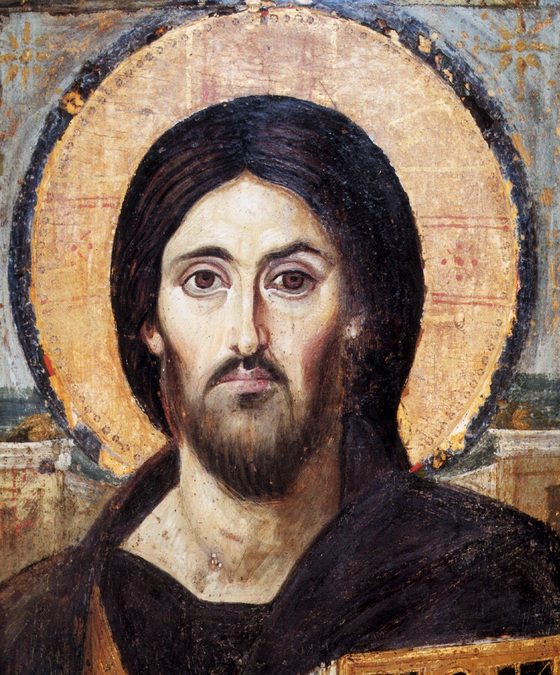
“But whom do you say that I am?”
“He said to them, ‘But who do you say that I am?’ Simon Peter answered, ‘You are the Christ, the Son of the living God.’”
Notice what Peter doesn’t say. Not “a great teacher”. Not “a good man”. He says something you’d never say about your favorite professor.
And Jesus doesn’t correct him; He tells Peter that “flesh and blood has not revealed this to you, but my Father who is in heaven.”7
Two thousand years later, that question hasn’t gone anywhere. It’s just been passed down the line, person to person. And now it’s got your name on it.
So what’s the Church’s answer? Weirder than you’d expect. And better.
02The claim
God became one of us
Here it is: Jesus is truly the Son of God who, without stopping being God, became a man and our brother.13 Not half and half, and not some smoothie of the two. The Catechism says it in six words: “Jesus Christ is true God and true man.”1
“The Word became flesh and lived among us. We saw his glory, such glory as of the only born Son of the Father, full of grace and truth.”
And “flesh” means flesh.14 The Gospels show him so worn out from walking that he just sits down by a well.15 After forty days without food, he’s hungry, like you’d be.16
The God who made galaxies, sitting by a well because His feet hurt. Sit with that for a second.
Which raises the obvious question. Why on earth would God do that?
03The reason
Why he came
The Catechism gives four reasons, and they’re short.17
To bring us back to God.2 So that we would know God’s love.18 To show us what a holy life looks like.19 And, most startling of all, to make us “partakers of the divine nature.”20
“For God so loved the world, that he gave his only born Son, that whoever believes in him should not perish, but have eternal life.”
Now read that list again. Every single reason is about you.
But here’s the thing. The whole story lives or dies on one claim. Did he actually rise from the dead?
04The evidence
A letter from about AD 56
The Catechism points you to a letter, which is a very un-mythical thing to do. “In about A.D. 56 St. Paul could already write to the Corinthians” what he’d been taught about Jesus.22
“For I delivered to you first of all that which I also received: that Christ died for our sins according to the Scriptures, that he was buried, that he was raised on the third day according to the Scriptures, and that he appeared to Cephas, then to the twelve. Then he appeared to over five hundred brothers at once, most of whom remain until now, but some have also fallen asleep.”
Look at that last line. More than five hundred people saw him at once, and most were still alive when Paul wrote. In other words: go ask them. That’s not how you write a legend.
The Church says the Resurrection is “a real event, with manifestations that were historically verified.”22 Not a metaphor; “the crowning truth of our faith in Christ.”3
And it’s honest about what we don’t know: “no one was an eyewitness to Christ’s Resurrection,” and no Gospel describes the moment itself. It stays right at the heart of the mystery.24
So where does that leave you, if you’re not sure yet? In good company, actually.
05Your answer
You do not need every answer today
Thomas, one of the Twelve, Jesus’ inner circle, missed the first appearance.2526 His friends are buzzing, and he basically says, prove it: “Unless I see in his hands the print of the nails, put my finger into the print of the nails, and put my hand into his side, I will not believe.”27
Eight days later, Thomas is in the room, and Jesus shows up.28 The biggest skeptic in the group says five words: “My Lord and my God.”29
Faith, the Church says, is “the free response of the human person to the initiative of God who reveals himself.”30 God makes the first move, and you get to answer; it’s His gift and your choice.3132
And questions aren’t the enemy: “faith seeks understanding.”33 One of the best lines ever written, from St. John Henry Newman: “Ten thousand difficulties do not make one doubt.”34
Peter answered on a road. You can take your time. The question will wait for you.
Your move
Try this, this week
- Read one Gospel slowly. Mark is the shortest. One chapter a day is plenty.
- Ask his question out loud. Read Mark 8:29 and answer it honestly, even if your answer is “I don’t know yet.”
- Write down your questions. Every question is welcome.
- Bring the list to someone. A priest or a Catholic friend.
You’ll need
- A Bible. Any Catholic edition works, or the Douay-Rheims text quoted on this page.
- About fifteen quiet minutes.
Remember Start with the person, not the rules.
If this is hard
If some of this is hard to swallow, that’s normal. Thomas needed a week and a hands-on demo. Keep reading, keep asking. A priest or a Catholic friend will happily talk it through with you, no pressure.
A question people ask
How do we know he rose from the dead?
Answered on video by Bishop Robert Barron · Full answer page
The Catechism calls the Resurrection a real event, with manifestations that were historically verified, as the New Testament bears witness.22 Peter and the Twelve were the primary witnesses, and Paul speaks of more than five hundred others to whom Jesus appeared.3536 It also remains at the very heart of the mystery of faith, as something that transcends and surpasses history.24
Only one thing to do
Your one next step
Tonight, read the first chapter of Mark. It takes a few minutes. You do not have to believe anything first. Just meet him.
Read Mark, chapter 1Step 1 of 8 · Becoming Catholic
If Jesus really is who Peter said He is, did He leave anything behind for us when He returned to the Father?
Step 2: Why a Church?Take it with you
Printable one-page cardDownload card (A4 PDF)Download card (US Letter PDF)Short link: stoneandincense.com/go/bc1
See it
.jpg)
Your real next step
This page can’t give you the sacraments. A parish can.
We’re just pointing. People walk with you. Find a Catholic parish near you, go to a Mass, or just ask a priest for ten minutes. You don’t need to have it figured out.
Notes
How we know · 36 sources for this page
- Catechism of the Catholic Church, paragraph 464. vatican.va
- Catechism of the Catholic Church, paragraph 457. vatican.va
- Catechism of the Catholic Church, paragraph 638. vatican.va
- Mark 8:27, World English Bible. read the chapter
- Mark 8:28, World English Bible. read the chapter
- Matthew 16:15-16, World English Bible. read the chapter
- Matthew 16:17, World English Bible. read the chapter
- Catechism of the Catholic Church, paragraph 436. vatican.va
- Catechism of the Catholic Church, paragraph 751. vatican.va
- Catechism of the Catholic Church, paragraph 752. vatican.va
- Catechism of the Catholic Church, paragraph 11. vatican.va
- Catechism of the Catholic Church, paragraph 461. vatican.va
- Catechism of the Catholic Church, paragraph 469. vatican.va
- John 1:14, World English Bible. read the chapter
- John 4:6, World English Bible. read the chapter
- Matthew 4:2, World English Bible. read the chapter
- Catechism of the Catholic Church, paragraph 457-460. vatican.va
- Catechism of the Catholic Church, paragraph 458. vatican.va
- Catechism of the Catholic Church, paragraph 459. vatican.va
- Catechism of the Catholic Church, paragraph 460. vatican.va
- John 3:16, World English Bible. read the chapter
- Catechism of the Catholic Church, paragraph 639. vatican.va
- 1 Corinthians 15:3-6, World English Bible. read the chapter
- Catechism of the Catholic Church, paragraph 647. vatican.va
- John 20:24, World English Bible. read the chapter
- Catechism of the Catholic Church, paragraph 551. vatican.va
- John 20:25, World English Bible. read the chapter
- John 20:26, World English Bible. read the chapter
- John 20:28, World English Bible. read the chapter
- Catechism of the Catholic Church, paragraph 166. vatican.va
- Catechism of the Catholic Church, paragraph 153. vatican.va
- Catechism of the Catholic Church, paragraph 154. vatican.va
- Catechism of the Catholic Church, paragraph 158. vatican.va
- Catechism of the Catholic Church, paragraph 157. vatican.va
- Catechism of the Catholic Church, paragraph 642. vatican.va
- 1 Corinthians 15:5-6, World English Bible. read the chapter
Excerpts from the English translation of the Catechism of the Catholic Church for use in the United States of America Copyright © 1994, United States Catholic Conference, Inc. – Libreria Editrice Vaticana. Used with Permission. English translation of the Catechism of the Catholic Church: Modifications from the Editio Typica copyright © 1997, United States Conference of Catholic Bishops – Libreria Editrice Vaticana. Scripture: World English Bible, Catholic edition (public domain), modern verse numbers; Douay-Rheims numbers in brackets where they differ. Early Christian writers: Ante-Nicene Fathers (1885, public domain). Video: “Who is Jesus?,” Bishop Robert Barron, supporting material, not a teaching source.
Scenes marked “Imagine” are an invitation to picture the moment, not a historical record. Stone & Incense restates Church teaching in plain words; our wording is not an official Church text. Report an errorCorrections.